50 Business Documents Every Small Business Needs
From offer letters to credit notes, here is the complete small business document checklist for 2026 — grouped into categories with plain-English explanations and a faster way to draft every one of them.
Why a document checklist matters more than a template folder
Ask ten small business owners how many different documents keep their business running and most will guess low. The real number — once you count employment paperwork, sales documents, invoicing, expense tracking, compliance forms, leases, and governance records — usually lands somewhere between forty and sixty distinct document types across a single financial year. Most of that paperwork never gets its own line item in a business plan; it accumulates quietly until an audit, a dispute, or a new hire forces someone to go looking for a document that does not exist yet.
The businesses that handle this well are not the ones with a lawyer on retainer. They are the ones with a checklist — a working map of which documents exist, which ones repeat every month, and which ones only show up once a year but still need to be right when they do. This guide is that checklist, organised into categories so you can scan for what applies to your business instead of reading fifty definitions end to end.
For each category we explain what the document actually does, who typically needs it, and where it fits in the life of a small business. Where a document is commonly generated, drafted, or sent through Signibly, we note that too — not because every business needs every tool, but because knowing a faster path exists changes how quickly you can act when a document is suddenly due tomorrow morning.
How to use this list without getting overwhelmed
You do not need all fifty of these documents on day one. A sole trader freelancing from a laptop might only ever need six or seven: a consulting agreement, an invoice, a receipt, a quote, a simple NDA, and a privacy policy for their website. A ten-person agency with contractors, a lease, and a small board will eventually touch closer to thirty. Treat this list as a reference you return to as your business grows, not a homework assignment to complete this weekend.
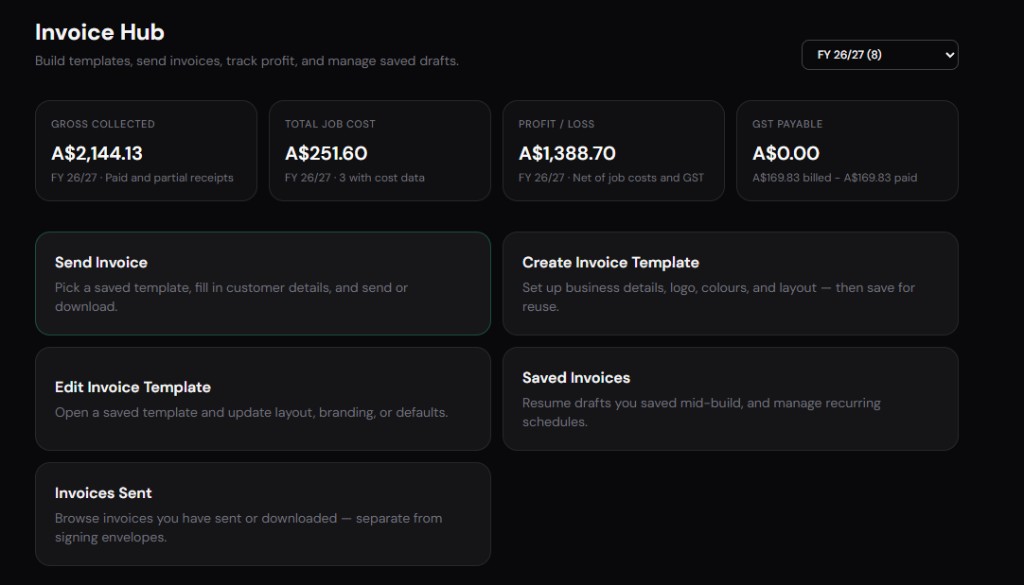
When you do need to produce one of these documents, there are three practical paths: write it from scratch (slow, and easy to miss a clause), start from a static template (faster, but generic and rarely jurisdiction-aware), or generate it with a structured AI wizard like Signibly AI, which asks for your roles, jurisdiction, and clauses before drafting a page-ready document with signature fields already placed. We link the relevant Signibly hub under most categories below so you can go from needing this document to having it drafted and ready to send in the same sitting.
Hiring and HR documents
Every hire — full-time, part-time, or casual — generates paperwork before their first day and periodically afterward. Getting these documents right protects both the business and the employee, and in most jurisdictions several of them are not optional.
An offer letter sets out the role, start date, salary, and reporting line before the formal contract is signed, giving the candidate something concrete to accept. The employment contract is the binding version — job description, compensation, probation period, notice requirements, and termination terms. An independent contractor agreement performs a similar function for non-employees, explicitly stating that the relationship is not employment, which matters for tax and liability purposes. A non-disclosure agreement (NDA) protects confidential information shared with new hires or contractors before they officially start. A non-compete or non-solicit agreement restricts a departing employee from immediately poaching clients or joining a direct competitor, though enforceability varies significantly by jurisdiction.
An employee handbook acknowledgment confirms in writing that a new hire has read and understood company policies, which matters if a policy is ever disputed later. A termination letter documents the reason, effective date, and final entitlements when an employment relationship ends, reducing the risk of a disputed dismissal. A timesheet records hours worked for payroll and, for contractors billing hourly, for invoicing. A leave request form creates a paper trail for annual leave, sick leave, and unpaid leave approvals. A performance review document captures periodic feedback and can become important evidence in a later disciplinary process.
Rounding out the HR set: a written warning documents a specific policy breach or performance issue ahead of any termination decision, and an employee reference letter — often requested months or years after someone leaves — confirms role, dates of employment, and sometimes performance, without exposing the business to unnecessary risk if kept strictly factual. Most of these documents follow a predictable structure, which is exactly the kind of document Signibly AI drafts well: open the wizard, choose the document type, set the jurisdiction, and the fields for signature and date are already placed when the draft is ready.
Client and sales documents
Before a contract exists, there is usually a proposal — a document that outlines scope, pricing, and timeline in a way designed to win the work, not just describe it. A quote or estimate is a more transactional cousin, typically shorter and used for well-defined, lower-value jobs like a single repair or a fixed scope of design work.
Once the client says yes, a service agreement becomes the binding document: what will be delivered, by when, for how much, and what happens if either side does not hold up its end. For engagements with multiple phases or deliverables, a statement of work sits underneath a broader contract and defines exactly what a specific phase includes, which is common in agency and consulting relationships.
A master service agreement is used when a client and vendor expect to work together repeatedly — it sets the general terms once, and each new project only needs a short statement of work referencing it, saving both sides from renegotiating boilerplate every time. Separately, terms of service govern how anyone — client or general visitor — is allowed to use a website, app, or online product, and are worth having even before the first paying client signs anything.
Freelance and consulting documents
Freelancers and independent consultants have a slightly different document set than agencies with staff, mostly because the same person is often negotiating, delivering, and invoicing the work. A consulting agreement sets fee structure, deliverables, and intellectual property ownership for advisory or expert work, while a freelancer contract does the same job for creative, technical, or project-based work with tighter scope definitions.
A retainer agreement locks in a recurring monthly fee for ongoing availability rather than a single project, which is common for fractional marketing, bookkeeping, or IT support roles. When scope shifts mid-project — and it usually does — a change order records the new deliverables and updated price in writing rather than over a text message thread nobody can find later. A short project brief, while not legally binding, keeps expectations aligned from day one and is often the source document an AI drafting tool uses to generate the formal agreement.
One document freelancers underuse is a simple scope boundary clause inside the consulting or freelancer contract itself, spelling out what counts as an included revision versus new, billable work. Without it, scope creep tends to happen gradually and informally through email, and by the time it is obvious the relationship has outgrown the original agreement, there is no written record of when or why that happened, which makes it awkward to raise a rate increase or bill for the extra work already delivered.
Invoicing and payment documents
The invoice is the most-produced document in most small businesses — a formal request for payment listing the work completed, the amount owed, and the due date. A receipt confirms that a payment has actually been received, which matters for both the customer records and the seller bookkeeping. A credit note reverses part or all of an invoice, typically issued after a refund, a billing error, or a returned item, and keeps the accounting trail clean instead of just deleting the original invoice.
A purchase order is issued by a buyer before work begins, authorising a supplier to proceed at an agreed price — common in B2B relationships where the buyer has a procurement process to follow. A payment plan agreement documents an instalment schedule when a client cannot pay a large invoice in one transaction, protecting the business if a later instalment is missed. A late payment notice is the formal escalation once an invoice passes its due date without payment, and having one ready removes the awkwardness of drafting it under pressure.
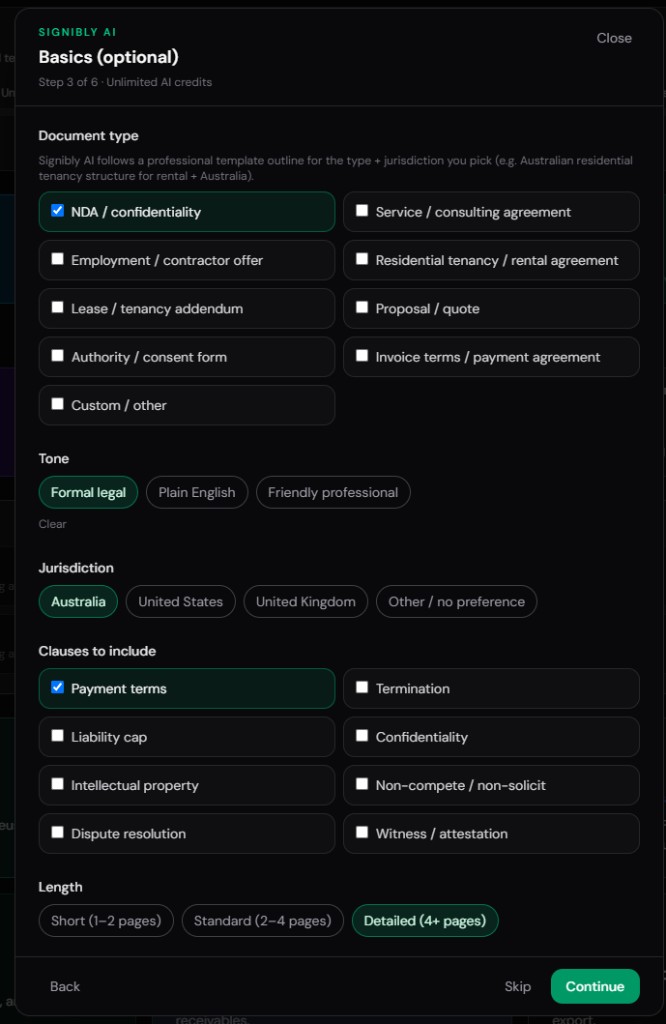
Because invoicing touches every sale a business makes, it is worth having this set built into the same workspace as your contracts rather than in a separate accounting app. Signibly Invoice Hub generates and sends invoices, tracks payment status, and can attach a signed contract or purchase order directly to the invoice record, so the paperwork trail for a single deal lives in one place instead of three.
Expense and financial tracking documents
On the outgoing side of the ledger, an expense report itemises business spending for reimbursement or tax purposes — fuel, software subscriptions, client entertainment, and small purchases that add up over a quarter. A reimbursement request form is the employee-facing version, used when staff pay for something out of pocket and need the business to pay them back. A mileage log tracks vehicle use for tax deduction claims, which many small business owners lose money on simply by not recording trips consistently.
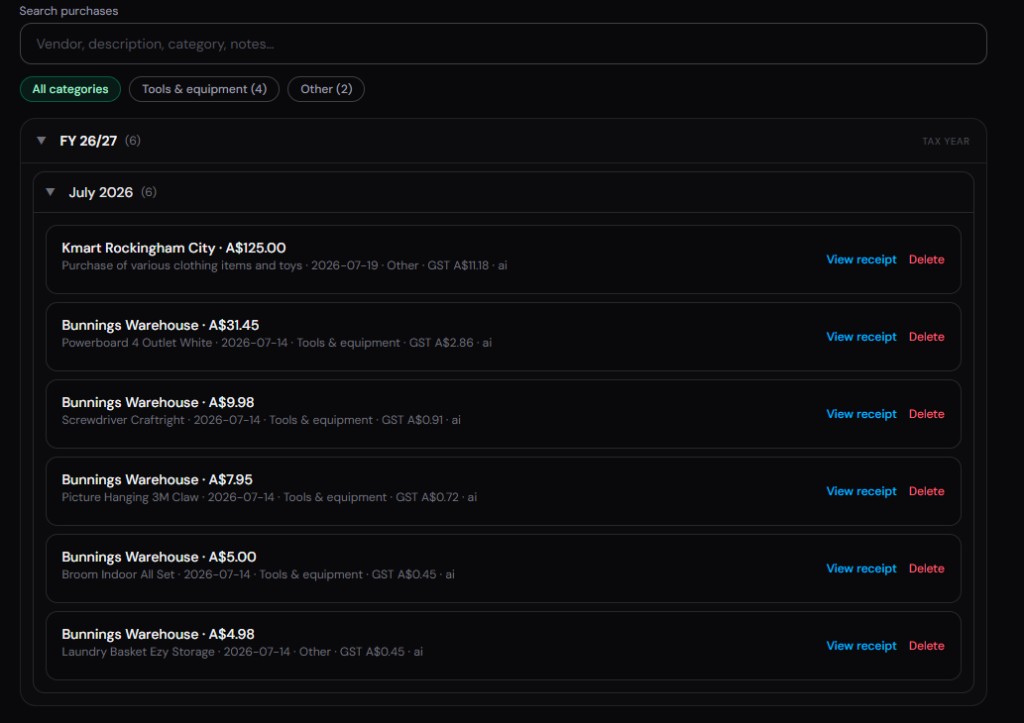
A petty cash log reconciles small, informal cash spending against a fixed float, which still exists in plenty of retail and trade businesses even in a mostly digital economy. A budget request form is used internally when a team member wants sign-off on a purchase above a set threshold before committing the business to it. Signibly Expenses Hub and Tax / BAS Hub share the same underlying data model as invoicing, so a receipt or invoice photographed on a phone can become a categorised expense line without manual re-entry, and quarterly tax summaries build themselves from the same records.
Legal and compliance documents
A privacy policy discloses what personal data a business collects, how it is used, and how customers can request its deletion — required by law in most jurisdictions once a business collects any personal information online, which today means almost every business with a website. Website or app terms and conditions set the rules for using a digital product and typically include liability limitations that matter if something goes wrong.
A data processing agreement is required when a business shares customer data with a third-party processor — a payroll provider, an email platform, or a CRM — and is increasingly requested by larger clients running their own vendor due diligence. A liability waiver or release form protects a business from claims arising from an activity with inherent risk, common in fitness, events, and trades. An indemnity agreement shifts financial responsibility for specific losses from one party to another and often appears as a clause inside a larger contract rather than a standalone document.
A business licence application is the formal registration document required to legally operate in a given industry or location, and its requirements vary enormously by jurisdiction and sector — this is one category where generic AI drafting is least useful and a local regulator or legal adviser should always be the primary source.
Property and lease documents
Businesses that operate from a physical space — a shop, an office, a warehouse — need a different document set entirely. A residential tenancy agreement applies to businesses renting out residential property as a side operation, such as small landlords and property managers, while a commercial lease agreement covers retail, office, or industrial space with materially different clauses around fit-out, outgoings, and permitted use. A sublease agreement lets an existing tenant rent part of their space to another business, subject to the head lease allowing it.
A property condition or inspection report documents the state of a space at move-in and move-out, which is the single most common source of bond and deposit disputes when it does not exist. A notice to vacate formally ends a tenancy on a set date and, depending on jurisdiction, must meet strict minimum notice periods to be enforceable. Property paperwork is one of the more standardised categories, which makes it a strong fit for jurisdiction-aware AI drafting — Signibly AI includes residential tenancy blueprints that follow a locally recognisable structure rather than an invented, generic layout.
Property managers handling several tenancies at once face a specific version of the documentation problem: the same set of forms needs to be produced correctly and quickly for every new tenant, with only names, addresses, and dates changing between them. This is exactly the repetitive, structured drafting task where a saved template combined with an AI wizard for jurisdiction variations outperforms manually editing a Word document for every new lease, particularly when a portfolio spans more than one state or country with different minimum notice and disclosure requirements.
Partnership and governance documents
Once a business has more than one owner, governance paperwork becomes essential even between friends and family. A partnership agreement sets out profit split, decision-making rights, and an exit process for a business with two or more partners operating without a formal company structure. A company or LLC operating agreement performs the same role for an incorporated entity, and a shareholder agreement adds provisions specific to share ownership, transfer restrictions, and what happens if a shareholder wants to sell their stake.
A board resolution formally records a decision made by a company board — approving a new bank account, a major purchase, or a new director — and is often required by banks or regulators as proof that a decision was properly authorised. Meeting minutes document what was discussed and decided in any formal meeting, and while informal for many small businesses, they become important evidence if a decision is ever challenged later. None of these documents are exciting to produce, which is exactly why they are the ones most likely to be skipped, until the day a bank, investor, or dispute makes them mandatory.
The common thread across governance documents is that they matter most exactly when relationships are under strain — a disagreement between co-founders, a shareholder wanting to exit, a bank asking for proof a decision was authorised before releasing funds. Producing them casually while everyone is getting along is far easier than trying to reconstruct an agreement about profit split or decision rights after a disagreement has already started, which is precisely why this category rewards being handled early rather than reactively.
Vendor and procurement documents
On the buying side of the business, a vendor agreement or supplier contract sets pricing, delivery terms, and quality expectations with a business you rely on to deliver goods or services. A delivery or acceptance note confirms that goods arrived in the agreed condition and quantity, which matters if a dispute over a damaged or short shipment arises later.
A service level agreement sets measurable performance commitments — uptime, response time, resolution time — for an ongoing vendor relationship, and is standard practice for any software, hosting, or managed service contract. A vendor confidentiality agreement protects sensitive pricing, process, or customer information shared with a supplier during a tender or ongoing relationship. Together with the purchase order covered above, this set of documents is what keeps a supply chain accountable on paper instead of on a handshake.
Smaller businesses often skip formal vendor paperwork with suppliers they consider low-risk — a regular print shop, a small local contractor — reasoning that the relationship is informal enough not to need it. That reasoning holds right up until a delivery is late for a client deadline, a supplier quietly changes pricing without notice, or a dispute over quality arises with no written quality standard to point back to. A one-page vendor agreement covering price, delivery timing, and a basic quality expectation closes most of that gap without needing a lengthy contract.
Choosing between AI, a template, or a lawyer for each category
Not every document on this list deserves the same drafting approach, and picking the right one saves both time and risk. Routine, repeatable documents that rarely change in substance — invoices, receipts, timesheets, standard NDAs, quotes — are ideal candidates for either a saved template or a quick AI draft, because the downside of a small error is low and the volume of these documents makes speed the priority. A business issuing forty invoices a month cannot realistically hand-draft each one, and does not need to; the structure barely changes from client to client.
Documents with moderate stakes but a recognisable structure — service agreements, consulting contracts, residential tenancy agreements, employment contracts for standard roles — are the strongest fit for jurisdiction-aware AI drafting specifically, because they benefit from adapting to different party counts and clause requirements without a lawyer needing to be involved every single time. A tool that lets you set jurisdiction and party roles before drafting captures most of the value a lawyer would add for a standard version of these documents, while still leaving room for a one-off legal check when a specific deal looks unusual.
High-stakes, irreversible, or heavily negotiated documents — partnership agreements, shareholder agreements, commercial leases with personal guarantees, contested terminations — are worth a lawyer regardless of how good the AI or template is, because the cost of a subtle error is measured in real money or real disputes rather than minutes of rework. We cover this trade-off in more depth in our dedicated guide comparing AI drafting against legal review for contracts specifically.
How often these documents actually need updating
A document drafted once and never revisited is a quiet liability, and different categories on this list decay at very different speeds. Compliance-linked documents — privacy policies, terms and conditions, data processing agreements — need review whenever the underlying regulation changes, which in an environment of evolving data protection rules can mean reviewing at least annually even if nothing about your business itself has changed in the meantime.
Employment-related documents need review whenever minimum notice periods, minimum wage figures, or leave entitlements change in your jurisdiction, which typically happens on a predictable annual or biannual cycle depending on location. Commercial documents like service agreements and NDAs age more slowly in substance but should still be revisited whenever your business changes what it actually offers, since a contract describing a service you no longer provide the same way creates ambiguity the moment a dispute forces someone to read it closely.
A simple habit keeps this manageable: pick one month a year as a document review month, pull the templates or saved AI drafts for your five or six most-used document types, and confirm nothing has changed in the underlying law or your own service offering since the last review. This single habit prevents the majority of the small, avoidable errors that quietly turn into disputes months or years later.

Which documents matter most at each stage of a business
A brand-new sole trader rarely needs more than six or seven documents in their first year: a service agreement or consulting agreement, an invoice, a receipt, a quote, a basic NDA, and a privacy policy if they have a website. Adding documents before they are needed mostly adds administrative overhead without reducing real risk, since the risk a document protects against usually has not materialised yet at this early stage.
A growing business with its first few hires typically adds employment contracts, an employee handbook acknowledgment, timesheets, and, if it starts working with external contractors, independent contractor agreements and a proper IP assignment agreement. This is also the stage where a master service agreement starts paying off, since repeat client relationships become common enough that renegotiating the same boilerplate for every new project starts to waste real time that could go into billable work instead.
An established business with a lease, multiple owners, or regular vendor relationships is the stage where governance documents, property paperwork, and vendor agreements typically get added, often reactively — a lease renewal forces a commercial lease review, a new investor forces a shareholder agreement, a larger client forces a data processing agreement. Getting ahead of this reactive pattern, even slightly, is one of the more valuable uses of a document checklist like this one, since it turns a scramble into a scheduled task.
Documents small businesses forget until it is too late
A few documents do not fit neatly into the categories above but cause outsized problems when they are missing. An intellectual property assignment agreement confirms that work created by a contractor or employee — code, designs, copywriting — actually belongs to the business that paid for it, rather than defaulting to the creator under copyright law in many jurisdictions. Without one, a business can pay for a logo, a website, or custom software and technically not own the rights to it.
A certificate of currency or proof of insurance is frequently requested by commercial landlords, larger clients, and government tenders before a contract is signed, and scrambling to get one on the day it is due is a common, avoidable delay. A subcontractor agreement, distinct from a general contractor agreement, is needed whenever a business hired as the prime contractor on a job brings in another business to complete part of the work, and it clarifies liability if that subcontracted work fails.
A succession or exit plan document, while rarely urgent, records what happens to the business if an owner dies, becomes incapacitated, or wants to sell, and is one of the few documents on this list that genuinely benefits from being drafted well before it is needed rather than during a crisis. None of these are exotic; they are simply the documents that only become visible once a specific situation forces the question, which is exactly when there is the least time to draft them properly.
What changes when your business operates in more than one place
A business trading in a single city under one set of local laws can usually get away with one version of each document type. The moment a business starts hiring interstate, leasing property in a second state, or taking clients in another country, that single-version approach quietly stops being reliable, because notice periods, tax treatment, consumer protection rules, and even signature validity requirements can differ from one jurisdiction to the next.
The most common failure mode is not realising a document needs a jurisdiction-specific version until a dispute or an audit exposes it — an employment contract drafted for one state applied unchanged to a hire in another state, or a standard terms and conditions page that assumes a set of consumer rights that do not actually apply where a particular customer is based. This is rarely deliberate; it usually happens simply because the original document worked fine for years before the business expanded.
This is one of the strongest arguments for jurisdiction-aware drafting over a single static template kept on file. Selecting jurisdiction as an explicit input each time a document is generated, rather than assuming it never changes, closes this gap without requiring a business to maintain a separate manually-tracked template library for every location it operates in.
Seasonal and one-off documents worth keeping ready in advance
A handful of documents on this list are needed rarely but urgently, which makes them worth having drafted and reviewed in advance rather than starting from scratch under time pressure. A termination letter and a written warning are the clearest examples — nobody wants to draft either while actively managing a difficult HR situation, and having a reviewed, jurisdiction-correct version ready before it is needed removes one source of stress from an already stressful moment.
End-of-financial-year documents follow a similar pattern in many businesses: expense summaries, annual reports for a company structure, and any documents needed for a tax filing tend to arrive as a concentrated burst of urgent work once a year rather than being spread evenly across twelve months. Businesses that keep their expense and invoice records continuously up to date throughout the year, rather than reconstructing them from receipts at the deadline, consistently find this seasonal crunch far less stressful than those attempting to catch up all at once.
A quick audit: which of these documents does your business actually have
Before adding a single new document to your workflow, spend fifteen minutes checking which of the categories above you already have covered, half-covered, or missing entirely. Half-covered is more common than most owners expect — a business might have an employment contract template from three years ago that has never been updated for a change in minimum notice periods, or an NDA that was drafted for one specific deal and has since been copied for a dozen unrelated ones without anyone checking whether the clauses still make sense.
The categories most commonly missing entirely in businesses under five years old are governance documents such as board resolutions and meeting minutes, vendor-side paperwork such as service level agreements and vendor confidentiality agreements, and the forgotten documents in the section above, particularly IP assignment. If your audit turns up more gaps than you expected, that is normal; the goal of this list was never to make anyone feel behind, only to make the gaps visible enough to close one document at a time.
A note on keeping signatures and originals organised as your team grows
A checklist of document types solves half the problem; knowing where the signed, finished version of each one actually lives solves the other half. It is common for a business to have a well-drafted service agreement template but no consistent place where the signed versions for each client end up, which means a dispute or an audit request turns into a scramble through individual inboxes rather than a quick lookup in one folder.
As soon as more than one person in a business can send documents for signature, this becomes a genuine risk rather than a minor inconvenience — two team members can easily end up using slightly different versions of the same contract template without realising it, or a signed original can sit only in the inbox of someone who later leaves the business. A shared, permissioned workspace where every document type on this list has one canonical template and every signed copy lands in the same place by default removes this risk without requiring anyone to remember a manual filing step.
Frequently overlooked details inside common documents
Even businesses that have every document type on this list sometimes miss small but important details inside them. Inside an NDA, the most commonly missed detail is a defined time limit on confidentiality obligations — without one, the agreement can be read as binding forever, which is rarely what either party actually intended and can make the clause harder to enforce cleanly if it is ever tested. Inside a service agreement, the most commonly missed detail is what happens to part-finished work if the engagement ends early, which matters far more often than most businesses expect.
Inside an invoice, a surprisingly common gap is the absence of a clear due date expressed as an actual date rather than a payment term like net thirty, which leaves room for genuine disagreement about when an invoice technically became overdue. Inside a residential tenancy or commercial lease, the detail most often skipped is a clear process for how maintenance requests are logged and actioned, which becomes the source of most day-to-day landlord and tenant friction long before rent itself becomes an issue.
None of these gaps are dramatic on their own, which is exactly why they survive unnoticed in so many businesses for years. They tend to surface at the worst possible time — mid-dispute, mid-negotiation, or mid-termination — which is the strongest argument for a periodic, calm review of your standard documents rather than only ever reading them closely once something has already gone wrong.
Digital vs physical originals: what actually needs to be kept
A question that comes up often once a business starts drafting and signing digitally: does a physical, printed original ever need to exist alongside the digital version. For the overwhelming majority of the documents on this list, in most jurisdictions, the answer is no — a properly executed e-signature with an accompanying audit trail is treated as a legally valid original in its own right, and printing a physical copy adds no additional legal weight, only additional filing burden.
A small number of document types in specific jurisdictions still carry additional formality requirements beyond a standard e-signature, such as certain wills, some property transfer deeds, and specific regulated filings, and it is worth confirming those specific requirements locally rather than assuming every document on this list can be handled identically. For everything else, treating the digital, signed version as the authoritative original, backed by proper storage and export capability, is both simpler and safer than maintaining a parallel paper filing system nobody consistently keeps up to date.
A note on liability, insurance, and the paperwork that connects them
Several documents on this list only make sense together with a business insurance policy sitting behind them, and it is worth understanding that connection rather than treating each document as independent. A liability waiver, for example, reduces risk but rarely eliminates it entirely, which is exactly why businesses in higher-risk activities still carry public liability insurance alongside a signed waiver rather than relying on the waiver alone. Similarly, an indemnity clause inside a vendor or service agreement is only as valuable as the counterparty ability to actually pay if that indemnity is ever called on, which is why larger contracts increasingly request proof of insurance as a condition of signing.
This is also why a certificate of currency, mentioned earlier as one of the easily forgotten documents, tends to surface as an urgent request precisely when a larger client or a commercial landlord is finalising a contract — the insurance requirement is often buried in a clause deep in the agreement, and confirming it can be satisfied before signing avoids a last-minute scramble that can delay an otherwise-ready deal by days.
Turning this checklist into drafted documents
A list like this is only useful if it shortens the distance between needing a document and having one that exists, is correct, and is ready to sign. That distance is usually where small businesses lose the most time, not because the documents are conceptually hard, but because starting from a blank page for the fifteenth time this year is exhausting.
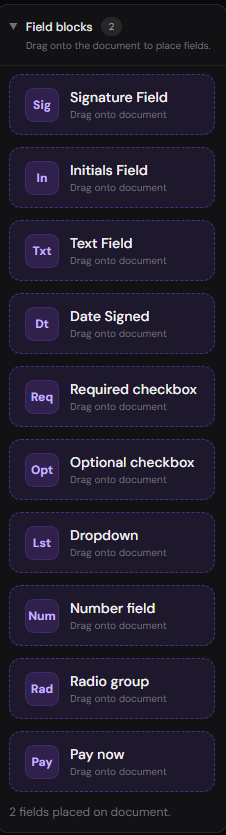
Signibly AI is built around exactly this list. Open the wizard, pick a document type — from employment contracts and NDAs to service agreements and residential tenancy agreements — set the jurisdiction, party roles, and any specific clauses, and the AI drafts a page-ready document with signature and date fields already placed near the relevant text. For documents you already have as a finished PDF from a lawyer or franchise, Auto-generate fields scans up to twenty pages and places fields automatically instead of you dragging each one manually.
From there the same workspace handles the rest of the lifecycle covered in this checklist: send the contract for e-signature, generate the invoice once it is signed, log the related expense if one exists, and keep every version in one team folder. Explore the full document type list and jurisdiction options in the Signibly AI guide, or start from a blank canvas in Templates if you already know the exact wording you want.
How many business documents does a typical small business actually need?
Most sole traders and freelancers need somewhere between six and twelve document types in their first year — a contract template, an invoice, a quote, an NDA, and a privacy policy cover the majority of transactions. Businesses with employees, a lease, or multiple owners typically grow into twenty to thirty document types within a few years, and larger operations touch most of the fifty listed here.
Can AI legally draft documents like employment contracts and leases?
AI can draft the structure and standard language of most commercial documents, but it is not a substitute for legal advice on complex, high-value, or regulated matters. Always review AI-drafted documents before sending them, and have a qualified professional check anything with significant financial or legal exposure, such as leases, shareholder agreements, or terminations in a disputed exit.
Do I need a lawyer to review every document on this list?
No. Routine, low-risk, repeatable documents such as invoices, receipts, quotes, standard NDAs, and timesheets rarely need individual legal review once the base wording is sound. Higher-stakes documents such as leases, partnership agreements, and disputed terminations are worth a professional review even if the first draft came from AI or a template.
Where can I create and send these documents without switching between multiple apps?
Signibly AI drafts the document, places signature fields automatically, and lets you send it for e-signature in the same workspace. Once signed, Invoice Hub and Expenses Hub handle the billing and expense side of the same deal, so a single business event does not require several separate subscriptions to document properly.
Related
Signibly AI guide · Templates · Invoice Hub guide · Expenses Hub guide · For small business · Pricing · Shelf-ware waste · Standalone tax · Hide unused features · Top 10 SMB software · FreshBooks vs Signibly · Track partial payments · DocuSign vs PandaDoc · AI document creation · PandaDoc vs SignNow · PandaDoc pricing 2026 · PandaDoc vs Adobe Sign · SignWell vs DocuSign · Signaturely vs DocuSign · Dropbox Sign & invoicing · eSignLive vs DocuSign · AI vs template contracts · AI fillable PDF guide · Complete document workflow · PandaDoc vs DocuSign vs Signibly · Hidden cost of five business apps · Best AI contract generators · AI vs lawyers for contracts · Client onboarding guide · Build a paperless business · Switch to Signibly AI · Scan receipts & invoices · Replace multiple apps · All-in-one SMB software · Custom dashboards · Freelancers · Get paid faster · Client management · Cheaper DocuSign alternative · Payments Hub · Tax / BAS Hub · Invoicing with e-signatures · Contracts + invoices hub · All blog posts · All solutions · Compare vendors