AI vs Lawyers: Should AI Create Your Contracts?
AI can draft a contract in minutes. A lawyer can tell you if it will hold up. Here is an honest breakdown of where AI helps, where templates help, where lawyers are still worth the fee, and how to review anything before you send it.
The question behind the question
Should I use AI to create my contracts is rarely the real question. The real question is usually some version of: can I skip paying a lawyer for this deal, or is that a mistake I will regret in six months. That is a fair thing to worry about, and the honest answer is neither yes, AI replaces lawyers, nor no, never trust AI with a contract — it depends entirely on what the contract is for, how much money is at stake, and how likely a dispute is.
This guide is deliberately not a sales pitch for AI drafting as a lawyer substitute. It is a breakdown of three tools — AI, static templates, and human lawyers — and where each one earns its place in a small business document workflow. Most businesses end up using all three at different times, and knowing which one to reach for is more valuable than picking a permanent side.
We will cover where AI genuinely helps, where templates are the better call, where a lawyer is still worth the fee, the specific legal risks of AI-only contracts, why jurisdiction changes the calculation, and a review process you can run on any contract, AI-drafted or otherwise, before you send it for signature. None of this is legal advice; it is a framework for deciding when to go get some.
AI vs templates vs lawyers at a glance
The honest answer to AI or lawyer is usually both, at different stages of the same deal. The table below summarises where each option tends to be strongest so you can match the tool to the task rather than the task to whichever tool happens to be open on your screen.
| Situation | AI drafting | Static template | Lawyer |
|---|---|---|---|
| Strong — fast, jurisdiction-aware | Good if reviewed recently | Usually unnecessary for routine use | |
| Useful as a starting draft only | Not flexible enough | Best fit | |
| Good, though templates are often faster | Best fit once reviewed once | Only for periodic review | |
| Useful with jurisdiction selection | Risky if not localised | Recommended | |
| Not sufficient alone | Not sufficient alone | Required |
Where AI genuinely helps
AI is at its best when the job is structure, speed, and consistency rather than legal judgment. A well-built AI drafting tool can turn a short set of answers — document type, party roles, jurisdiction, length, tone, and any specific clauses — into a complete first draft in the time it takes to make a coffee. For a service agreement, an NDA, or a standard consulting contract, that first draft is often ninety percent of the way to something sendable.
AI is also better than most humans at consistency across repeated documents. If your business sends the same type of contract to twenty different clients a year, an AI wizard applies the same clause structure and formatting every time, whereas a person manually editing a Word template is one distracted afternoon away from sending a client the wrong company name or a pricing clause that expired last year.
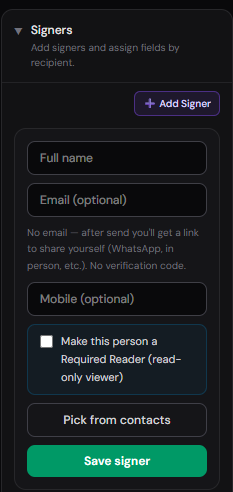
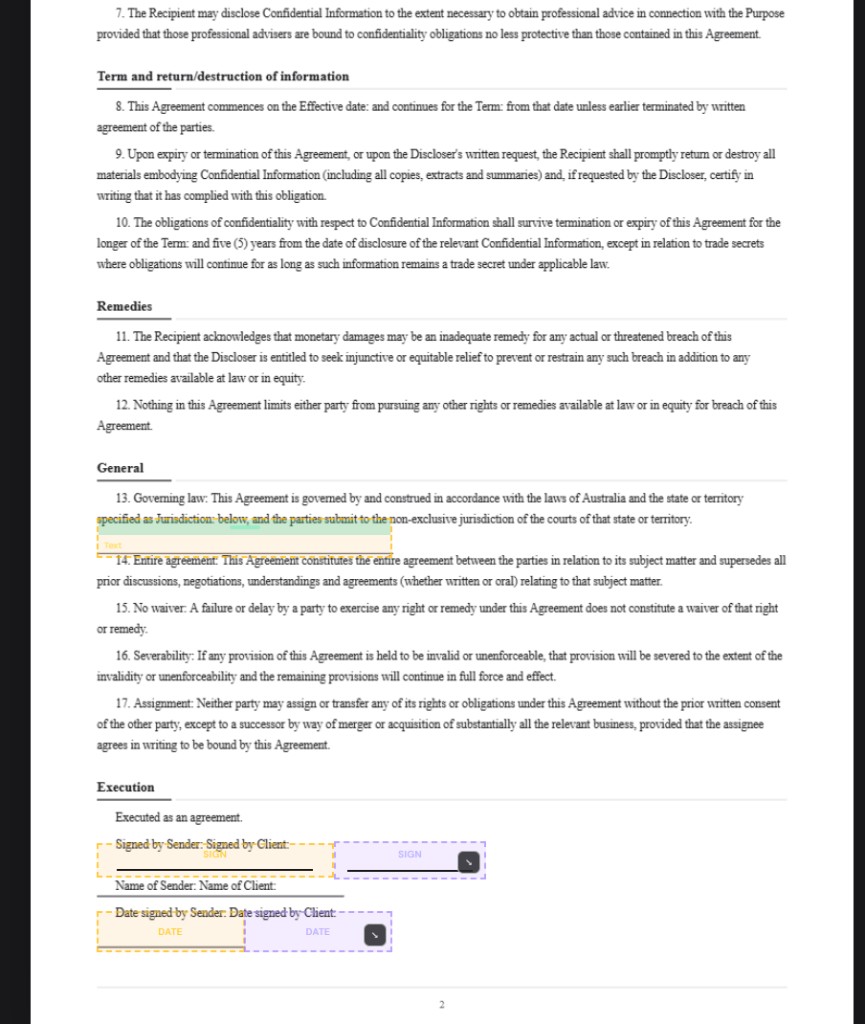
The other underrated strength is that a good AI drafting tool does not stop at text. Tools like Signibly AI place signature and date fields directly onto the generated pages, assign colours per party, and let you test the document as any signer before sending, turning a draft into something actually ready to sign rather than a file you still need to reformat and manually tag in a separate e-signature product.
Where lawyers still matter
Lawyers earn their fee in exactly the places AI is weakest: judgment calls specific to your situation, negotiation leverage, and knowledge of how a clause has actually played out in disputes in your jurisdiction. AI can tell you what a standard indemnity clause usually says. A lawyer can tell you whether the specific wording protects you against this particular counterparty, in this particular industry, given the deal you are actually doing.
High-stakes and irreversible decisions are the clearest case for legal review: selling equity in your business, signing a commercial lease with a personal guarantee, terminating a senior employee where a disputed dismissal claim is plausible, or entering a contract with a counterparty in a different country with materially different enforcement mechanisms. In these situations, the cost of a lawyer is small compared with the cost of getting it wrong.
Lawyers are also the right call whenever a deal is genuinely being negotiated rather than simply accepted. AI drafts a starting position well; it does not represent your interests across a back-and-forth negotiation with a counterparty who has their own lawyer pushing for different terms. That kind of adversarial back-and-forth is a human skill, not a drafting task.
Where templates still earn their place
Static templates sit in a useful middle ground: cheaper and faster than a lawyer, more predictable than a fresh AI draft because the wording never changes once you have reviewed it once. For a business that sends the exact same type of agreement — the same NDA, the same standard terms — dozens of times a year with only names and dates changing, a template that has already been checked once is often the most efficient option available.
The weakness of templates is that they age badly and rarely account for jurisdiction differences out of the box. A template downloaded from a generic website years ago may reference outdated notice periods, superseded regulations, or a jurisdiction that is not yours at all. Templates need a periodic review just like any other document, ideally whenever a relevant law changes and at minimum once a year, which is a step many small businesses skip until a dispute reveals the gap.
A closer look at how AI drafting tools actually generate a contract
It helps to understand roughly what happens between typing in a document type and receiving a formatted draft, mostly because it explains both the strengths and the failure modes covered elsewhere in this guide. A structured AI drafting tool does not simply ask a language model to write a contract from a single sentence; it collects specific inputs — document type, jurisdiction, party roles and counts, length, tone, and any requested clauses — and uses those inputs to select and assemble a jurisdiction-appropriate structure before generating the specific language for each section.
This structured, blueprint-based approach is what keeps output consistent between one generation and the next for the same document type, and it is meaningfully different from an open-ended chatbot prompt, which can produce a different structure, different section ordering, and different clause coverage every time even for an identical request. The trade-off is that a structured tool is only as good as the blueprints and jurisdictions it has been built to cover, and will be less reliable outside that coverage than a general-purpose model might first appear to be.
Understanding this also explains why revisions work the way they do in most tools: asking for a change in plain language, such as extending a notice period or adding a confidentiality clause, is interpreted against the existing structure rather than regenerating the whole document from scratch, which is why targeted revisions tend to be faster and more predictable than asking for a complete rewrite.
Common misconceptions about AI and contracts
A common myth is that a contract drafted with AI assistance is somehow less legally binding than one drafted by a human. That is false: what makes a contract enforceable is proper execution — capacity, consent, consideration, and a valid signature — not who or what typed the first draft. An AI-drafted contract, properly reviewed and signed, is just as binding as one drafted entirely by hand.
A second myth is that AI drafting and static templates are basically the same thing. They are not: a template is fixed until someone manually edits it, while an AI wizard adapts structure and clause selection based on the specific inputs you give it each time, which matters when party count, jurisdiction, or requested clauses change from one document to the next.
A third and more dangerous myth is that professional-sounding output must be correct. Fluent, well-formatted language creates a false sense of completeness, which is exactly why the review process below exists — the polish of an AI draft has no bearing on whether a specific clause is enforceable in your specific jurisdiction for your specific deal.
The legal risks of AI-only contracts
The biggest risk with AI-drafted contracts is not that the AI writes something obviously wrong; most modern tools produce professional, coherent language. The risk is confident-sounding text that is subtly incomplete: a missing termination clause, an ambiguous payment term, or a liability cap that does not actually match the risk of the work being done. Language models can generate plausible legal-sounding clauses without any guarantee that a specific clause is enforceable in your jurisdiction.
A second risk involves the line between drafting assistance and legal advice — in some jurisdictions and for some document types, presenting AI-generated output as tailored legal counsel rather than a drafting starting point can create liability for whoever is offering the service, not just the business using it. Reputable AI drafting tools are explicit that they draft documents rather than provide legal advice, and that distinction matters both practically and legally.
A third and more mundane risk is simply not reading the output. Because AI drafts arrive looking polished and complete, it is tempting to skim rather than read every clause, the opposite of what a new document deserves. A five-minute read of an AI-drafted contract before sending it is the single most common mistake this guide can help you avoid.
A word on AI hallucination and how it applies to contracts specifically
Hallucination, the tendency of a language model to produce confident, plausible-sounding statements that are factually wrong, is often discussed in the context of AI making up facts or citations, but it applies to contract drafting in a more specific and dangerous way. A hallucinated clause in a contract is not obviously false the way a made-up historical fact might be; it typically reads as a perfectly normal, professionally worded clause that simply does not reflect an actual legal requirement or does not match the specific deal it was inserted into.
This is precisely why fluency is not a useful signal of correctness in this context, and why the review process described in this guide focuses on checking substance — parties, terms, dates, exit conditions — rather than checking whether the language sounds professional, which it almost always will regardless of whether the underlying content is actually correct for your situation.
Why jurisdiction changes everything
Contract law is not global. Notice periods for employment termination, cooling-off rights for consumer contracts, the enforceability of non-compete clauses, and even what makes a signature legally valid all vary by country and, within countries like Australia and the United States, by state. A contract clause that is standard and enforceable in one jurisdiction can be unenforceable or even unlawful in another.
This is why jurisdiction-aware AI drafting matters more than raw language quality. A tool that lets you specify jurisdiction and then drafts from structured, jurisdiction-appropriate blueprints, rather than one generic template reworded for every country, is meaningfully safer than a general-purpose chatbot asked to draft a residential tenancy agreement with no jurisdiction context at all. Signibly AI takes this approach deliberately: it drafts from curated, jurisdiction-aware structures rather than claiming to browse the live web for the latest law, which is a claim no responsible AI drafting tool should make.
A practical review process for any contract
Whether a contract came from AI, a template, or a lawyer, the same review habits apply before you send it. Start with the parties: correct legal names, correct roles, correct number of signers if there are multiple clients or tenants. This sounds obvious and is the single most common error found in rushed contracts.
Next, check the commercial terms line by line: price, payment schedule, delivery or completion dates, and what happens if either side misses a deadline. Then check the exit terms, how the agreement can be terminated, by whom, and with how much notice, because most disputes are actually about how a relationship ends rather than how it started. Finally, check that signature and date fields are correctly placed for every party, and if the platform allows it, test the document as each signer before sending it for real.
For anything above a threshold you set for your business — a dollar value, a new type of counterparty, an unusually long commitment period — add one more step: a paid, focused legal review of just the risky clauses rather than the whole document. Many lawyers will review a specific clause or two for a flat fee far cheaper than drafting from scratch, which gets you targeted expertise without the cost of full legal drafting.
How AI drafting and contract review actually differ as tasks
It is worth separating two tasks that get conflated in this debate: drafting a document and reviewing one that already exists. Drafting is largely a structural, generative task — assembling the right sections, in the right order, with reasonable default language — and this is exactly the kind of task AI performs consistently well, especially within a defined jurisdiction and document type.
Reviewing an existing document, whether AI-drafted, template-based, or received from a counterparty, is a different and arguably harder task: it requires spotting what is missing rather than judging what is present, noticing an unusual clause buried in otherwise standard language, and understanding how a specific clause would actually play out for your specific business if a dispute arose. AI tools are improving at flagging unusual or missing clauses, but this reviewing task still benefits far more from human judgment than the initial drafting task does, which is exactly why the review step in this guide is not optional regardless of how the first draft was produced.
How to brief a lawyer efficiently once you decide you need one
When a document does warrant legal review, the way you brief the lawyer materially affects both cost and turnaround time. Arriving with a specific, already-structured draft, whether from AI or a template, and a short list of the exact clauses or concerns you want checked, is far more efficient and considerably cheaper than asking a lawyer to draft an entire agreement from a blank page and a verbal description of the deal.
This is one of the more underrated ways AI drafting and legal review complement each other rather than compete: the AI draft does the structural, time-consuming first pass, and the lawyer spends their more expensive time on the judgment calls that actually require it, such as whether a specific liability cap is appropriate for this deal or whether a termination clause exposes you to unnecessary risk given your specific circumstances. Framing the engagement this way, as a targeted review rather than full drafting, typically reduces legal fees substantially for routine but moderately important documents.
A short glossary for this decision
A few terms get used loosely in this debate and are worth pinning down. Drafting is the act of producing the first version of a document, whether by a lawyer, a template, or AI, and drafting alone does not make a document safe to sign. Review is the separate act of checking a draft, whether that review is a five-minute self-check against the process below or a paid legal review of specific clauses, and it is the step most often skipped when a document arrives looking finished.
Enforceability refers to whether a court would actually uphold a specific clause if tested, which depends on jurisdiction, the specific wording, and the specific facts of the deal, and is not something any drafting tool, human or AI, can fully guarantee in advance for every possible dispute. Legal advice specifically means guidance tailored to your particular facts and objectives, delivered by someone qualified to give it, which is categorically different from a drafting tool producing generic, professional-sounding clauses, no matter how confident that output looks on the page.
A note on cost: what each option actually costs a small business
Cost comparisons in this space are often unfair to one side or another, so it is worth being specific. A lawyer drafting a contract from scratch typically bills by the hour, and even a straightforward service agreement can run into several hundred dollars once initial drafting and a round of revisions are included, which is a reasonable cost for a document that will be reused or that carries real risk, but a poor use of budget for a document sent once and rarely revisited.
A subscription-based AI drafting tool typically costs a small monthly fee covering a pool of document generations, which becomes dramatically cheaper per document as usage increases, but carries the review responsibility described throughout this guide rather than a lawyer verified result. A static template is usually the cheapest option per use once an initial version has been reviewed, but that initial review, whether by a lawyer or a careful self-check against the process in this guide, is where the real cost and the real risk both concentrate.
The realistic budget-conscious approach for most small businesses is a combination: pay for a genuine legal review once on your two or three most-used, highest-stakes document types, then use AI drafting or saved templates for the volume of lower-stakes documents that follow, reserving further paid legal review for the specific deals that actually warrant it rather than applying it uniformly to every document that crosses your desk.
What small business owners actually get wrong most often
In practice, the most expensive mistakes in this area are rarely about choosing AI over a lawyer or vice versa. They are about skipping the review step entirely, regardless of where the draft came from, because the document arrived looking complete and nobody built in a habit of checking it. A lawyer-drafted contract that nobody reads before signing carries exactly the same blind-trust risk as an AI-drafted one; the source of the draft is not what protects a business, the review is.
A second common mistake is assuming that because a document worked fine for the last ten clients, it will work fine for the eleventh without re-reading it against the specifics of that new deal. Contracts are not one-size-fits-all even within the same document type — a service agreement that fits a two-week project does not automatically fit a six-month retainer with different payment milestones and risk exposure, and reusing one without adjustment is a common source of disputes that has nothing to do with AI at all.
A third mistake, more specific to AI adoption, is treating a single successful AI-drafted contract as proof the tool can be trusted blindly going forward. One good result does not guarantee the next one is equally solid, particularly if the next document involves an unusual clause, an unfamiliar jurisdiction, or a higher dollar value than the one that built initial confidence in the tool.
A decision framework you can actually apply
Rather than memorising every distinction in this guide, a simple three-question framework covers most real situations. First, is this document type routine and repeatable for my business, or is it unusual — routine points toward AI or a reviewed template, unusual points toward at least a targeted legal check. Second, what is the realistic financial or reputational downside if a specific clause turns out to be unenforceable or missing — a low downside supports moving quickly with AI, a high downside justifies the time and cost of legal review.
Third, is the counterparty likely to negotiate, or simply accept the terms as presented — an acceptance-only situation is well served by a strong AI or template draft, while a genuine negotiation benefits from a lawyer representing your specific interests through the back-and-forth. Running through these three questions takes less time than drafting the document itself, and consistently applying it across a business prevents both the two most common failure modes: over-lawyering routine paperwork, and under-reviewing the deals that actually carry real risk.
Where Signibly fits, without overselling it
Signibly AI is built to be the fast, structured drafting layer in this picture, not a lawyer replacement. It asks for jurisdiction, party roles, length, and clauses before drafting, places signature fields automatically, and lets you test every signer before sending, which covers the AI-helps and fast-first-draft parts of this guide well. It is explicitly not a source of legal advice, and every draft should still go through the review process above.
For businesses that already know their standard agreements are legally sound because a lawyer reviewed the base structure once, Signibly Templates lets you save that reviewed version and reuse it indefinitely, combining the reliability of a lawyer-reviewed document with the speed of not redrafting it every time. That combination — lawyer-reviewed base terms, AI speed for variations, and a clear line for when to call a lawyer again — is a more honest and more durable strategy than treating AI or lawyers as an either-or choice.
Is it legal to use AI to draft a business contract?
Yes, drafting a contract with AI assistance is legal in virtually every jurisdiction. What matters is that the resulting document is reviewed before it is signed, and that AI is used as a drafting aid rather than represented as formal legal advice for a specific legal problem.
Can AI replace a lawyer for a small business?
Not for every situation. AI is well suited to structured, repeatable, lower-stakes documents such as standard NDAs, service agreements, and consulting contracts. It is not a substitute for a lawyer on high-value, disputed, regulated, or heavily negotiated matters, where local legal judgment materially changes the outcome.
Does Signibly AI provide legal advice?
No. Signibly AI drafts practical commercial documents based on your inputs and jurisdiction selection. It does not provide legal advice, and every draft should be reviewed by you, and by a qualified professional for higher-stakes matters, before it is sent for signature.
How do I know if a contract needs a lawyer instead of AI?
As a rule of thumb, involve a lawyer when the dollar value is high, the relationship is genuinely being negotiated rather than accepted as-is, the counterparty is in a different jurisdiction, or the outcome of a dispute would be expensive or damaging to your business. Routine, repeatable, lower-risk agreements are generally safe to draft with AI or a reviewed template.
Related
Signibly AI guide · Templates · E-Signatures · 50 business documents checklist · For small business · Pricing · Shelf-ware waste · Standalone tax · Hide unused features · Top 10 SMB software · FreshBooks vs Signibly · Track partial payments · DocuSign vs PandaDoc · AI document creation · PandaDoc vs SignNow · PandaDoc pricing 2026 · PandaDoc vs Adobe Sign · SignWell vs DocuSign · Signaturely vs DocuSign · Dropbox Sign & invoicing · eSignLive vs DocuSign · AI vs template contracts · AI fillable PDF guide · Complete document workflow · PandaDoc vs DocuSign vs Signibly · Hidden cost of five business apps · Best AI contract generators · Client onboarding guide · Build a paperless business · Switch to Signibly AI · Scan receipts & invoices · Replace multiple apps · All-in-one SMB software · Custom dashboards · Freelancers · Get paid faster · Client management · Cheaper DocuSign alternative · All blog posts · All solutions · Compare vendors