DocuSign vs PandaDoc: Which Is Better in 2026?
An independent-style comparison of DocuSign and PandaDoc for 2026 — pricing, proposals, compliance, and workflows — plus an honest guide to which platform fits your team.
Why people compare DocuSign and PandaDoc in 2026
DocuSign and PandaDoc both sit on the short list when a business needs electronic signatures — but they are not interchangeable. DocuSign is the long-standing category leader for compliant e-signatures and enterprise contract workflows. PandaDoc grew up around sales documents: proposals, quotes, pricing tables, and contracts in one send.
If you landed here from a search like "DocuSign vs PandaDoc," you are usually deciding between two different philosophies: proven signing infrastructure (DocuSign) versus quote-to-close document automation (PandaDoc). Neither is "wrong." The better pick depends on whether your pain is legal/compliance signing or sales proposal velocity.
This guide is written for owners, ops leads, and sales managers at small and mid-sized businesses — not enterprise procurement teams running a six-month RFP. Prices and plan names change often; treat every dollar figure as directional and confirm on each vendor's site before you buy.
The one-sentence summary
Choose DocuSign when your priority is trusted, widely accepted e-signatures and you may already live in an ecosystem of CRM, ERP, or legal tools that standardise on it.
Choose PandaDoc when your priority is interactive proposals — pricing tables, product catalogues, and content blocks — and you want signing bundled into a sales document workflow.
If your weekly work is not only "get this PDF signed" but also "invoice the client, track partial payments, and log job receipts after the deal," neither platform is a complete operations hub on its own. We come back to that at the end.
What DocuSign is built for
DocuSign's core job is electronic signatures with an audit trail that legal and compliance teams recognise globally. Templates, routing orders, reminders, identity options, and completion certificates are mature. For many organisations, "send it through DocuSign" is shorthand for a defensible signing process — that brand trust matters when you work with larger clients or regulated industries.
Where DocuSign stretches beyond signing, it often does so through higher tiers, add-ons, or separate products such as contract lifecycle management (CLM). A five-person agency sending service agreements and NDAs may never touch CLM — but may still pay for a plan packaged for broader enterprise use.
DocuSign integrates deeply with Salesforce, Microsoft, Google Workspace, and hundreds of other systems. If IT has already standardised on DocuSign, switching costs are real even when the monthly line item feels high for how few envelopes you send.
What PandaDoc is built for
PandaDoc is best understood as a document automation platform for revenue teams. You build proposals and contracts from reusable blocks, embed pricing tables, pull products from a catalogue, and track when prospects open, read, and forward a link. Signing is the close of that journey — not a standalone envelope in isolation.
That makes PandaDoc strong for B2B sales cycles with configurable quotes: agencies pitching retainers, SaaS sellers with tiered plans, consultants packaging optional modules. Analytics on document engagement — time on page, sections viewed — are first-class, where DocuSign either does less or pushes you toward other products.
The trade-off is weight. If you only need a compliant signature on a static PDF twice a month, PandaDoc's editor, content library, and CRM-oriented workflow can feel like bringing a proposal studio to a job that only needed a pen — and the subscription often reflects that broader scope.
Pricing in 2026 (directional)
DocuSign personal and small-business plans are commonly quoted in USD from roughly the mid-teens to mid-forties per month depending on envelopes, seats, and region — with business and enterprise tiers climbing from there. Lower tiers frequently include send limits or feature gates; "unlimited" signing is usually not where entry plans start.
PandaDoc list pricing typically starts higher for teams that need the full proposal builder — often from the mid-thirties USD per user/month and up for business features, with document volume and advanced automation on upper tiers. Annual billing and seat minimums are common.
Both vendors run trials rather than permanent free tiers for full functionality. Factor in overage fees, extra seats, payment processing fees (where applicable), and regional tax — especially if you bill in AUD but buy in USD. A cheaper-looking headline per user can grow once you add the second seat or hit document quotas.
DocuSign vs PandaDoc: feature comparison
The table below compares the two platforms directly. It does not include every niche enterprise module — it focuses on what small and mid-sized teams ask about first when evaluating signing software.
| Feature | DocuSign | PandaDoc |
|---|---|---|
| Primary strength | Industry-standard e-signatures & audit trails | Proposals, quotes & sign in one flow |
| Typical starting price | ~$15–45 USD/mo personal; business higher | ~$35+ USD/mo per user (plan dependent) |
| Send / document limits | Common on lower tiers | Document quotas by plan |
| Templates | Strong template & envelope model | Templates + content library & blocks |
| Pricing tables in documents | Limited; not the core product | Core feature — interactive tables |
| Proposal / quote builder | Not native; often separate tools | Native editor & workflows |
| Document view analytics | Basic; deeper in enterprise tiers | Built-in engagement analytics |
| Payments in documents | Add-ons / integrations | Native payment blocks (Stripe, PayPal, etc.) |
| Bulk / high-volume send | Available; tier dependent | Available; tier dependent |
| Contract lifecycle (CLM) | Separate enterprise CLM product | Workflow automation; lighter than full CLM |
| Invoicing & AR after the deal | Not native — integrations elsewhere | Not a full invoice hub — focus stays pre-close |
| Integrations ecosystem | Very large (CRM, ERP, identity) | Strong CRM & sales-stack focus |
| Mobile signing experience | Mature signer UX | Mature signer UX |
| Free tier | Trial-focused | Trial-focused |
| Best default audience | Legal ops, HR, firms standardising on DocuSign | Sales teams closing configurable deals |
Real-world scenarios (who actually wins)
Scenario A — B2B SaaS sales team: Your reps send tiered quotes weekly, clients negotiate optional modules, and marketing wants every proposal on-brand. PandaDoc usually wins. DocuSign would still require a proposal tool upstream, then a separate envelope for the final PDF — two systems, two training paths.
Scenario B — HR and policy acknowledgements: You distribute the same policy PDF to forty staff, collect ordered signatures, and archive completion certificates for audits. DocuSign is the familiar choice. PandaDoc can do it, but you are not using the features you pay for.
Scenario C — Agency or tradie with signed work orders plus monthly invoicing: You need authority forms signed on site and deposit invoices tracked until the job closes. Neither DocuSign nor PandaDoc is a full operations hub — both handle the signature moment well, but ongoing invoice status, partial payments, and receipt and invoice photos for job costing typically live in other apps unless you standardise on a broader workspace.
Scenario D — Enterprise buyer mandates DocuSign: Your client’s procurement portal lists approved vendors and DocuSign is on the list. Compatibility beats price. Keep DocuSign for counterparty acceptance even if your internal team prefers another editor for proposals.
Implementation effort and admin time
DocuSign implementation for a small team is often "upload PDF, drag fields, send" within a day. Template libraries grow over months. The admin burden spikes when you add conditional routing, bulk sends, or identity verification — features that sit behind higher tiers or professional services.
PandaDoc implementation is front-loaded: content library design, product catalogue setup, and CRM field mapping reward teams that invest admin time early. Reps then send faster. Without that setup, PandaDoc feels like an expensive editor you could have replaced with a Word template and a signing link.
For either platform, budget ongoing owner time for template hygiene — expired pricing, old logos, and ex-employees on CC lists are where document platforms quietly embarrass you in front of clients.
Security, data residency, and IT review
Both vendors publish security certifications and data processing terms suitable for vendor security questionnaires. DocuSign’s enterprise sales motion assumes IT and legal will read them; PandaDoc’s materials target commercial teams with security FAQs for mid-market buyers.
If your industry requires specific data residency (EU-only storage, Australian preferences, etc.), verify current region options on each vendor’s trust page — policies evolve and differ by plan. Do not rely on a comparison blog for compliance decisions.
Retention and export matter when a client disputes a signature two years later. Confirm how long completed documents stay accessible on your plan and whether bulk export is included or billed as professional services.
Compliance and legal acceptance
Both DocuSign and PandaDoc support electronic signatures designed to meet common e-signature laws (such as eIDAS in the EU and the ESIGN Act in the US) when used correctly — identity, consent, and record retention matter as much as the vendor logo.
DocuSign's advantage is incumbency: counterparties rarely question a DocuSign link. PandaDoc is widely accepted in commercial B2B sales but may raise a eyebrow in highly formal procurement if the buyer expected a bare PDF and a traditional signing portal.
Neither replaces legal advice on which signature level you need for a given transaction. Qualified signatures, in-person ceremonies, and sector-specific rules still sit with your counsel — not with a blog comparison.
Workflow fit: sales-led vs operations-led
PandaDoc wins the hour before the deal closes. Merge fields, optional line items, and branded proposal themes shorten the path from "here is what we will do" to "here is what you signed." If your CRM drives the process and reps live in pipeline stages, PandaDoc aligns naturally.
DocuSign wins the hour after everyone agreed the terms exist. Upload the final agreement, place fields, route to signers in order, collect completion certificates, and archive. Operations, HR, and property workflows often look like that — less merchandising, more certainty.
Problems start when one team buys for sales and another for operations without agreeing on a system of record. You can end up paying twice and still exporting PDFs manually into accounting tools.
Integrations and long-term lock-in
DocuSign's integration catalogue is a moat. If you already pay for Salesforce seats, Microsoft 365 governance, or SAP connectors, DocuSign may be the path of least resistance even if the per-seat price stings.
PandaDoc integrates well with HubSpot, Pipedrive, Zoho, and other sales stacks — plus payment providers inside documents. If your stack is CRM-centric and proposal speed is the KPI, PandaDoc's connectors match the buyer.
Lock-in is not only API depth. It is templates, clause libraries, and trained staff. Migrating fifty active proposal templates or two hundred envelope templates is a project — budget that hidden cost when comparing headline monthly fees.
Limitations worth knowing (cons of each)
DocuSign cons: Pricing is tiered for enterprise breadth — CLM, advanced analytics, and modules you may never open can inflate the bill. Send caps and seat math surprise teams who thought "unlimited" was entry-level. Invoicing, expense logging, and ongoing payment-status tracking after a contract is signed are not native; most SMBs still run Xero, FreshBooks, or a second app for money movement.
PandaDoc cons: Power comes with complexity and cost per seat. Teams that only need signatures pay for proposal machinery. Document quotas and editor learning curves frustrate non-sales users (trades, HR, external accountants). Post-signature operations — recurring invoices, partial payments, receipt capture for job costing — still spill into other subscriptions once the proposal is won.
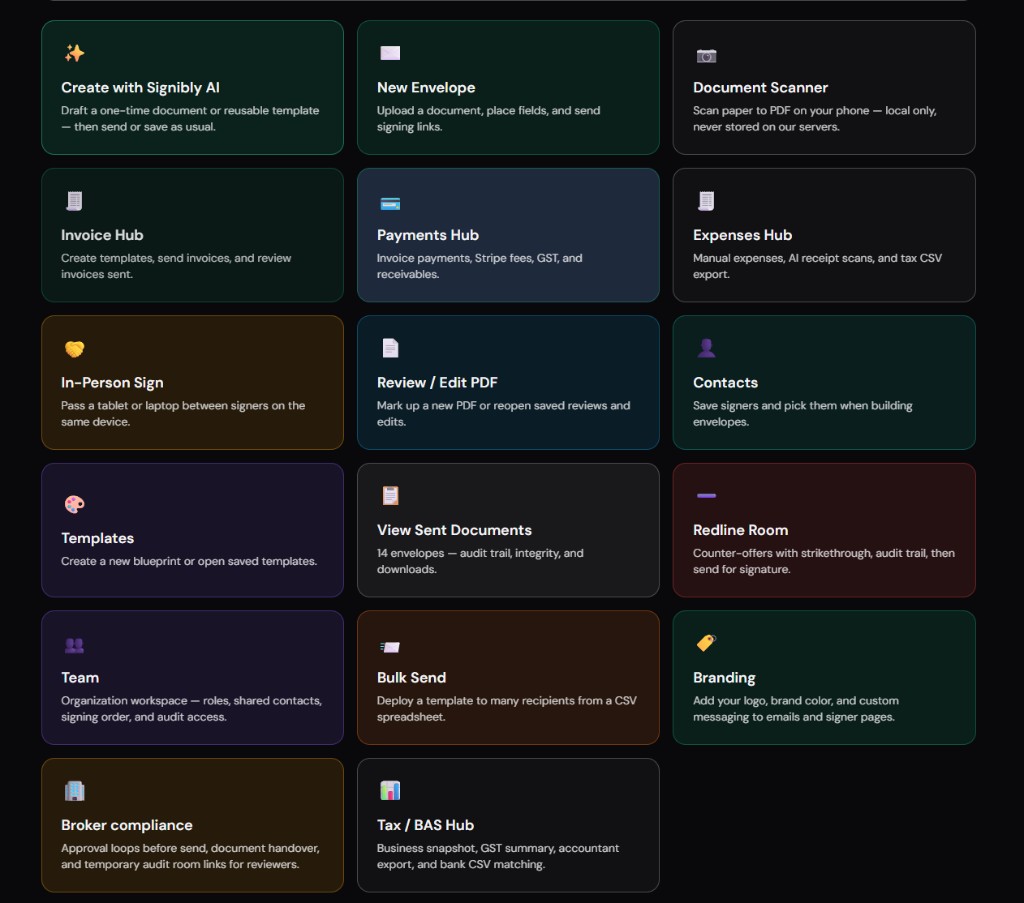
That post-signature gap is where broader workspaces help. Signibly publishes a Free plan at $0/month with three envelopes and one manual invoice per month, and a Business plan from $10/month AUD (shown in your local currency at checkout) with unlimited envelopes and invoices under fair use, plus Invoice Hub and Payments Hub alongside e-signatures — a different buying decision than picking between DocuSign and PandaDoc alone.
Which should you choose?
Choose DocuSign if you want the most recognised signing brand, your clients or compliance team expect DocuSign specifically, you need deep enterprise integrations, or your work is mostly "execute this agreed PDF" rather than "merchandise this deal in a proposal builder."
Choose PandaDoc if your sales team lives in proposals — configurable pricing, reusable content blocks, and document analytics — and you want payment collection inside the same send without assembling a custom stack first.
Consider a broader ops platform (Signibly is one example) if you need everything above plus day-to-day invoicing, payment status dashboards, expense receipts, and tax-prep exports under one published plan — especially when you would otherwise pay for DocuSign or PandaDoc and still buy separate invoicing and receipt apps. Signibly is fair if you only sign today and stronger when you turn on hubs you were going to pay for elsewhere; see our DocuSign and PandaDoc comparison pages if you want a feature-level look at how we differ.
Still unsure? Run a two-week pilot with real documents — one typical proposal and one typical contract — and count logins, admin time, and what you still do in email or Excel after the signature lands. The winner is the tool that reduces total workflow friction, not the one with the longest feature checklist.
Is DocuSign or PandaDoc cheaper in 2026?
It depends on seats and usage. DocuSign entry personal plans can look cheaper on paper for signing-only work; PandaDoc often costs more per user because it includes proposal tooling. Compare total cost including seats, document limits, and any payment fees — not just the first month of a trial.
Can PandaDoc replace DocuSign?
For sales proposals and quote-to-sign workflows, often yes. For enterprise-standard signing across HR, legal, and IT with CLM and deep ERP integrations, DocuSign is still the safer default. Many teams use PandaDoc upstream for sales and DocuSign downstream for formal contracts — duplication you should avoid if possible.
Which is better for small business?
Small businesses that sell with customised quotes lean PandaDoc. Small businesses that receive "please sign via DocuSign" from enterprise clients lean DocuSign for compatibility. If you mainly invoice and occasionally sign, evaluate whether either tool is more than you need.
Do I still need invoicing software with DocuSign or PandaDoc?
Usually yes. Both focus on documents and signatures (plus PandaDoc payments on the proposal). Ongoing invoices, partial payments, GST-style reporting, and receipt storage typically require accounting or ops software — unless you standardise on an all-in-one hub that includes those modules.
Related
Signibly vs DocuSign · Signibly vs PandaDoc · Cheaper DocuSign alternative · Invoicing with e-signatures · Pricing · Shelf-ware waste · Standalone tax · Hide unused features · Top 10 SMB software · FreshBooks vs Signibly · Track partial payments · AI document creation · PandaDoc vs SignNow · PandaDoc pricing 2026 · PandaDoc vs Adobe Sign · SignWell vs DocuSign · Signaturely vs DocuSign · Dropbox Sign & invoicing · eSignLive vs DocuSign · AI vs template contracts · AI fillable PDF guide · Complete document workflow · PandaDoc vs DocuSign vs Signibly · Hidden cost of five business apps · Best AI contract generators · 50 business documents checklist · AI vs lawyers for contracts · Client onboarding guide · Build a paperless business · Switch to Signibly AI · Scan receipts & invoices · vs Xero · vs FreshBooks · vs QuickBooks · vs SignNow · vs Zoho Books · Replace multiple apps · All-in-one SMB software · Custom dashboards · All blog posts · All solutions · Compare vendors