The Ultimate Guide to Client Onboarding
From first lead to paid, happy customer — the complete client onboarding pipeline for small businesses: proposal, contract, signature, invoice, payment, and what happens next.
Client onboarding is a pipeline, not a moment
Most small businesses think of onboarding as the paperwork that happens right after someone says yes — the contract, maybe an invoice. In practice, onboarding starts the moment a lead shows real interest and does not finish until that person or company has become a repeat, paying customer who trusts the way your business operates. Treating it as a single step instead of a seven-stage pipeline is one of the most common reasons deals stall, get lost, or leave a bad first impression despite good work.
A well-run onboarding pipeline has seven recognisable stages: capturing and qualifying the lead, sending a proposal that actually converts, turning that proposal into a signed contract, collecting the signature without friction, invoicing the moment the deal closes, collecting payment quickly, and converting the transaction into an ongoing customer relationship. Skipping or rushing any single stage tends to create a problem two stages later — a vague proposal produces a disputed contract, a slow signature process delays the invoice, and a slow invoice delays cash in the bank.
This guide walks through each stage with the specific documents, decisions, and tools involved, and shows how the whole pipeline can run inside a single connected workflow rather than across four disconnected apps. The goal is not to add more process for its own sake; it is to remove the gaps where deals currently leak time, clarity, or money.
Why the seven stages should be thought of as one connected pipeline
It is tempting to treat each of the seven stages below as an isolated task owned by whoever happens to be available — sales handles the proposal, admin handles the invoice, someone else chases payment. In small businesses without a dedicated team, this often means the same person handles all seven stages, but even then, treating them as separate tasks rather than one connected pipeline leads to the same problem: information gathered in stage one gets lost by the time stage three happens, and a detail agreed verbally in stage two never makes it into the written contract in stage three.
Thinking of onboarding as one pipeline rather than seven separate tasks changes a subtle but important habit: instead of starting fresh at each stage, each stage should pull directly from the one before it. The proposal should be built from the qualifying call notes, the contract should be built from the accepted proposal, and the invoice should be built from the signed contract, so that the same set of facts about the deal, price, and scope flows through every document without being retyped and potentially altered along the way.
Stage 1: Capturing and qualifying the lead
Every onboarding pipeline starts with a lead, but not every lead deserves the same amount of onboarding effort. Qualifying a lead early, confirming budget, timeline, decision-making authority, and genuine fit for what you offer, saves hours later spent drafting proposals for people who were never going to sign. A short intake form or a five-minute discovery call is usually enough to separate a real opportunity from someone still window shopping.
What you capture at this stage should feed directly into the next one. The scope discussed on a call, the budget range mentioned, and any specific requirements or constraints all belong in your notes, because they become the raw material for the proposal. Businesses that skip this step often end up writing a generic proposal and hoping it lands, instead of a specific one built from what the prospect actually told them they needed.
What good qualification questions actually sound like
Qualification works best as a short, specific conversation rather than a generic checklist read aloud. Useful questions tend to focus on outcome rather than feature: what does success look like for you in three months, what happens if this problem stays unsolved, and who else besides you needs to sign off before we can start. These questions surface budget reality, urgency, and decision-making authority far more reliably than directly asking how much do you have to spend, which often produces a guarded or unhelpful answer.
Equally important is asking about timeline expectations explicitly rather than assuming — a prospect who needs something delivered in two weeks has a fundamentally different conversation ahead than one exploring options for a project starting next quarter, and pricing, proposal detail, and even whether to proceed at all can reasonably differ based on that answer alone.
Stage 2: Sending a proposal that converts
A proposal is not a contract; it is a sales document designed to win the work by demonstrating that you understood the brief and have a credible plan to deliver it. The strongest proposals are specific: they name the actual problem the client described, outline a clear scope and timeline, and price the work in a way that is easy to say yes to, whether that is a single fixed fee or a small set of tiered options.
Speed matters more than most businesses realise. A proposal sent within twenty-four hours of a qualifying conversation, while the client still remembers the details and urgency of their problem, converts meaningfully better than the same proposal sent four days later after they have spoken to two other vendors. This is one of the clearest places where a fast drafting tool earns back real revenue, not just time.
Handling the client who wants to start before the contract is signed
A common pressure point in this stage is a client asking to begin work immediately, before the contract is signed, usually because of a genuine deadline on their side. Refusing outright can feel unnecessarily rigid, but starting with nothing in writing exposes the business to exactly the dispute risk contracts exist to prevent, particularly around scope and payment if the relationship sours before signing catches up.
A workable middle ground many businesses use is a short, one-page letter of intent or a deposit invoice sent alongside the full contract, confirming the core commercial terms — scope, price, start date — while the complete agreement is finalised and signed within an agreed short window, typically a few days. This protects the business with something in writing immediately while still allowing genuinely urgent work to begin without a multi-day delay for full contract negotiation.
Stage 3: Turning the proposal into a contract
Once a client accepts a proposal, the terms need to become a binding agreement — a service agreement, a statement of work, or for recurring work, a master service agreement with a shorter statement of work attached. This is the point where vague proposal language such as ongoing support as needed needs to become specific contract language: response times, scope boundaries, and what counts as an additional billable request.
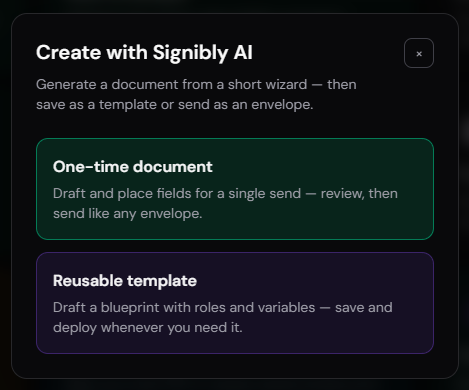
This stage is where AI drafting earns its place in the pipeline: rather than manually rewriting a template for every new client, a structured wizard can turn the accepted proposal details — party names, scope, price, timeline — into a properly formatted contract with signature fields already placed, in a fraction of the time it takes to draft manually. The faster this step happens after a yes, the less time there is for a client to second-guess the decision.
Stage 4: Getting the signature without friction
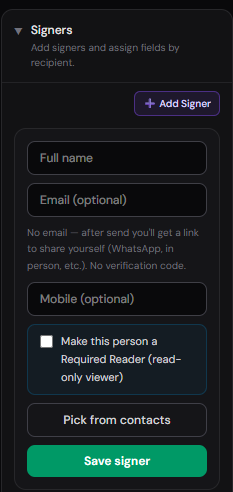
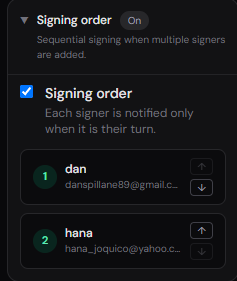
A contract that sits unsigned in an inbox is not a contract yet, and every extra step between here is the agreement and it is signed is a chance for the deal to stall. Fields should be placed correctly for every party before sending, with no hunting for where to sign and no ambiguity about which date goes where. For deals with multiple signers, signing order controls whether all parties can sign simultaneously or need to sign in sequence, and reminders keep a slow signer from quietly forgetting.
For higher-stakes engagements, an e-witness step or a full audit trail adds a layer of verification that some contracts genuinely need, without slowing down the vast majority of everyday agreements that do not. The best practice here is testing the document as each signer role before sending it for real, catching a missing field or a mislabelled party while it still costs nothing to fix, rather than after a client has already flagged it.
A note on pricing presentation inside the proposal
How pricing is presented inside a proposal affects conversion almost as much as the price itself. A single number with no breakdown can feel arbitrary to a client trying to judge value, while a granular, itemised breakdown of every small task can overwhelm and invite line-by-line negotiation on parts that were never meant to be optional. A middle path — a small number of clearly named deliverables or phases, each with a price, and one total — tends to convert best because it gives the client enough structure to understand what they are buying without opening every element to individual negotiation.
Offering two or three tiered options, rather than a single take-it-or-leave-it price, also tends to improve conversion, partly because it shifts the client decision from whether to proceed at all to which level of engagement to choose, which is a meaningfully easier decision for most people to make quickly.
Stage 5: Invoicing the moment the deal closes
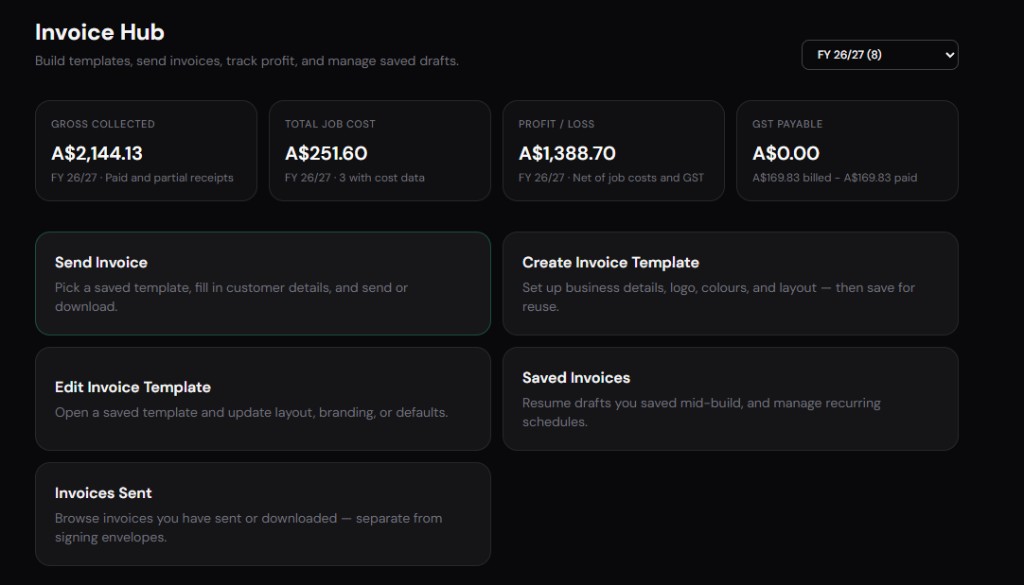
The gap between contract signed and invoice sent should be measured in minutes, not days. Every day that gap stays open is a day of delayed cash flow for no reason other than the invoice has not been created yet. Businesses that attach the invoice to the same envelope as the signed contract, or trigger it automatically the moment the last signature lands, consistently get paid faster than those treating invoicing as a separate, later task.
The invoice itself should mirror the contract exactly — same scope, same price, same payment terms — because any mismatch between what was signed and what is billed is the single most common source of payment disputes and delayed approvals on the client side, especially in businesses where the person who signs the contract is not the person who approves the invoice.
Why the invoice-to-payment gap deserves special attention
Of all seven stages, the invoice-to-payment gap tends to be the one businesses monitor least closely and lose the most cash flow to. Unlike a stalled proposal or an unsigned contract, an unpaid invoice does not usually feel urgent day to day, since the work is already done and the relationship already exists, which paradoxically makes it easier to let slide without the same sense of risk a stalled deal earlier in the pipeline would create.
That lack of urgency is exactly the problem: an invoice sitting unpaid for an extra two weeks across dozens of clients over a year adds up to a meaningful, entirely avoidable gap in available cash, particularly for businesses that are themselves paying suppliers, contractors, or staff on tighter terms than they are collecting from their own clients. Treating this stage with the same active attention as the earlier, more visibly urgent stages, through automated reminders and a clear escalation path for genuinely overdue accounts, closes one of the largest and most fixable leaks in a typical small business onboarding pipeline.
Stage 6: Collecting payment fast
Getting an invoice out quickly only matters if it also gets paid quickly. A deposit collected at signing, even a modest one, meaningfully reduces the risk of a client who signs and then goes quiet before work starts, and it is far easier to request a deposit as a standard term than to chase it after the fact. For larger engagements, a payment plan agreement with clear instalment dates protects both sides better than an open-ended arrangement to pay when convenient.
Automated payment reminders, sent a few days before and after a due date, recover far more late payments than manual chasing, mostly because they happen consistently rather than whenever someone remembers to follow up. Offering more than one payment method — card, bank transfer, and where relevant a payment plan — removes friction that has nothing to do with whether the client can afford to pay, just how easy it is to actually do so.
What happens when a stage gets skipped entirely
Understanding the failure modes of each stage makes the value of running all seven more concrete. Skip stage one, qualification, and stage two becomes a wasted proposal for a prospect who was never going to convert. Skip stage three, the formal contract, and any disagreement during delivery has nothing written to resolve it against, leaving the outcome to whoever argues their memory of the conversation more persuasively.
Skip stage four, a properly structured signature process, and a contract sits unsigned indefinitely while work quietly begins anyway, which is one of the most common sources of unpaid or disputed work in small service businesses. Skip stage five, prompt invoicing, and cash sits uncollected for no reason other than administrative delay. Skip stage six, active payment collection, and overdue invoices accumulate simply because nobody followed up. Skip stage seven, and the business perpetually pays the full cost of new-client acquisition for work that a slightly better process would have converted into a repeat, lower-cost relationship instead.
Stage 7: Converting the transaction into an ongoing customer
The seventh stage is the one most businesses skip entirely: turning a completed, paid job into an actual ongoing relationship. A short check-in after delivery, asking whether the work met expectations and whether there is follow-on work worth discussing, costs almost nothing and is where a meaningful share of repeat business and referrals originate, simply because so few competitors bother to ask.
Saving the contract structure used for this client as a reusable template, and keeping their documents, invoices, and communication history in one place, makes every future engagement with the same client faster to onboard than the first one. That compounding speed, each repeat client taking less admin time than the last, is the actual long-term payoff of building a proper onboarding pipeline instead of improvising it every time.
Measuring your onboarding pipeline instead of guessing at it
Most small businesses can describe their onboarding process in a sentence but cannot say how long it actually takes from proposal sent to first payment received, because nobody is tracking the gaps between stages. That single number, time from proposal to paid, is one of the most useful metrics a service business can track, because every day it shrinks is a day of cash flow pulled forward and a day less opportunity for a deal to stall or a client to change their mind.
A simple way to start measuring without new software is to timestamp four moments for your next ten deals: when the proposal was sent, when the contract was signed, when the invoice was sent, and when payment was received. Looking at the gaps between those four dates usually reveals exactly one stage where most of the delay concentrates — often the gap between contract signed and invoice sent, since that step is the easiest one to quietly deprioritise once the excitement of a closed deal has passed.
Once you know where the delay actually lives, fixing it is usually a process change rather than a tooling change: a rule that invoices go out the same day a contract completes, or that proposals go out within twenty-four hours of a qualifying call. Tooling that automates the handoff, such as generating an invoice the moment a contract finishes signing, simply makes the process change automatic rather than dependent on someone remembering to follow the new rule.
Onboarding for repeat clients vs first-time clients
A first-time client needs every stage of the pipeline run in full: qualification, a specific proposal, a full contract, and a clear payment structure, because there is no existing trust or track record to shorten the process. A repeat client, by contrast, often only needs a much lighter version of stages two through five, since the underlying relationship, payment terms, and working style are already established from the previous engagement.
The mistake many businesses make is running the same heavyweight process for a returning client that they run for a brand-new one, which unnecessarily slows down deals that should be some of the fastest and easiest in the business to close. Saving the previous engagement structure as a template, and only adjusting scope, dates, and price for the new project, turns a repeat client onboarding into a five-minute task instead of a half-day one, and is one of the clearest returns on the template-saving habit described in stage seven above.
The full pipeline running in one workspace
Each of the seven stages above can technically run in a different tool — a CRM for leads, a proposal app, a separate e-signature platform, a separate invoicing tool, a separate payment processor. Most small businesses run exactly this fragmented setup, and it works, but it costs time at every handoff: re-entering the same client details three or four times, checking multiple apps to see where a deal actually stands, and reconciling records that live in different systems.
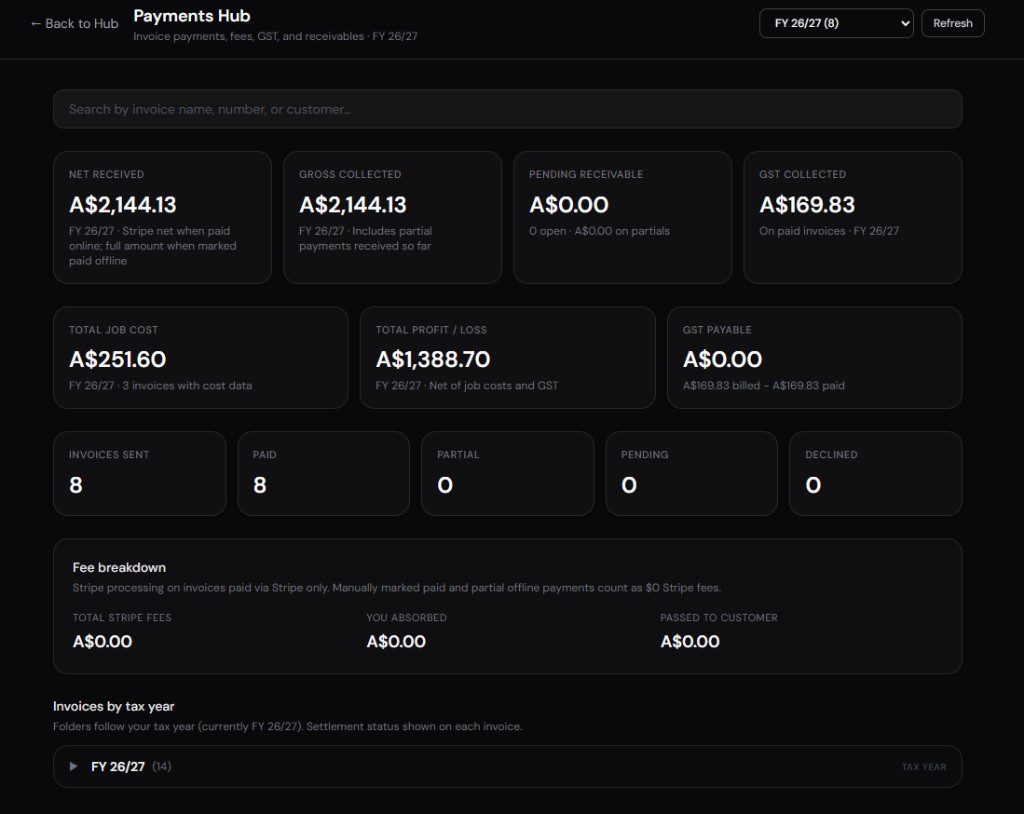
Signibly is built to run stages two through seven in one workspace. Signibly AI drafts the proposal-to-contract stage with jurisdiction-aware structure and auto-placed fields. E-signature handles signing order, reminders, and optional e-witness. The moment a document completes, Invoice Hub can generate the invoice, even attaching it to the same envelope, and Payments Hub tracks who has paid and who is due a reminder. Templates saves the whole structure for the next client in the same category.
None of this requires switching plans as the business grows — a single Business subscription from $10 a month AUD covers unlimited envelopes and invoices under fair use, with AI credits included for the drafting stage. The result is not a fundamentally different sales process, just a much shorter one, with fewer places for a deal to quietly stall between yes and paid.
Common onboarding mistakes worth avoiding
The most expensive mistake is treating the contract and invoice as an afterthought to the work itself, sending the agreement days after work has already started because the client was in a hurry. This routinely leads to disputes over exactly what was agreed, precisely because nothing was actually agreed in writing before the work began.
A close second is sending a generic proposal that does not reference anything specific from the discovery conversation; clients notice immediately when a proposal reads like it was sent to five other companies unchanged, and it undermines trust before the relationship has even started. A third common mistake is invoicing on a delay because the client already knows it is coming; clients do not prioritise invoices that have not technically arrived yet, no matter how well they know one is due.
The least visible mistake, and arguably the most costly over time, is never running stage seven, the follow-up and template-saving step, which means every new client feels like the first client, with none of the speed gains a properly built onboarding pipeline should be generating by year two.
Handling awkward moments in the pipeline gracefully
Not every onboarding runs smoothly, and how a business handles the awkward moments often matters more to the client relationship than how smoothly the easy parts went. A client who wants to negotiate the price after receiving a proposal is not a failed onboarding; having a clear, pre-decided floor for what you will and will not adjust prevents an uncomfortable back-and-forth from turning into an improvised discount that undercuts your next ten proposals as well.
A client who goes quiet after signing but before paying a deposit is a more serious warning sign, and a polite, direct follow-up after a set number of days, rather than an indefinite wait, protects both the relationship and your own planning — either the client responds and the engagement proceeds, or the silence itself is useful information about whether to hold the slot in your schedule. Scope disagreements after work has started are best handled by referring back to the specific written scope in the contract rather than relying on memory of the original conversation, which is exactly why a precise, specific contract at stage three pays for itself the first time a disagreement arises.
What to keep on file after every completed onboarding
Once a client has been fully onboarded and the first invoice is paid, a small amount of record-keeping pays off significantly the next time you work with them or a similar client. Keep the signed contract, the final invoice, and a brief note of any scope adjustments made along the way in one place tied to that client, rather than scattered across email threads that become hard to search after a few months.
Also worth keeping: which proposal version and pricing structure they accepted, since this becomes useful reference the next time you price a similar engagement, and any specific preferences or constraints the client mentioned during onboarding, such as a preferred invoice format or a specific approval process on their end, so the next engagement with them starts already knowing that detail instead of relearning it.
Onboarding notes by business type
Agencies and consultancies typically run the longest version of this pipeline, since proposals often involve multiple stakeholders on the client side and contracts frequently include a statement of work layered under a broader master agreement. The main risk for this group is stage three dragging on through internal client approvals; keeping the contract short and specific, with scope changes handled through a separate change order rather than renegotiating the whole agreement, keeps this stage from stalling.
Trades and field services businesses usually compress stages one through four into a single visit or call — a quote given on-site becomes the accepted proposal, and a short standard contract can be signed on a phone before work starts. For this group, the biggest onboarding win is usually stages five and six: invoicing and collecting a deposit before leaving the job site, rather than mailing an invoice and waiting weeks for a cheque.
Freelancers and solo consultants often skip stage one almost entirely, since most leads arrive already somewhat qualified through referral or a warm introduction, which means the real leverage in their pipeline sits in stages two through six: a fast, specific proposal, a same-day contract, and a deposit collected at signing to protect against the single client who disappears after agreeing to start.
Onboarding larger clients with multiple stakeholders
Larger clients introduce a wrinkle every stage of this pipeline needs to account for: more than one person may need to review the proposal, more than one person may need to sign the contract, and the person approving the invoice may not be the person who signed the agreement. Multi-party signing order becomes genuinely useful here rather than a nice-to-have, letting you define whether a procurement lead needs to sign before a finance lead, or whether all parties can sign in any order without holding up the process.
It also helps to confirm the invoice approval process explicitly during the contract stage rather than discovering it after the deal is signed — some larger clients require a purchase order to exist before they can pay an invoice at all, which is exactly why the purchase order document from the broader small business document checklist matters more for this segment of clients than for smaller, single-decision-maker deals.
A short onboarding checklist you can reuse for every new client
Before the call: confirm the prospect matches your ideal client profile on budget and scope, and prepare a short list of clarifying questions rather than a generic pitch. During the call: capture the specific problem in the client own words, the timeline they need, and any constraints, since this becomes the raw material for a proposal that reads as tailored rather than generic.
Within twenty-four hours: send a proposal referencing the specific details from the call, with clear pricing and a defined next step. On acceptance: convert the proposal to a contract the same day, place fields correctly for every signer, and send immediately. On completion: generate the invoice from the same data as the contract within the hour, not the week, and confirm a deposit or full payment term before work begins if that is your standard practice.
After delivery: send a short check-in asking whether expectations were met and whether there is follow-on work worth discussing, and save the contract and pricing structure as a template if this client type is likely to recur. Running through these five checkpoints for every new client turns a process that could easily take two weeks of back-and-forth into one that can realistically complete within a few days when nothing is holding it up.
What are the stages of a client onboarding pipeline?
A complete pipeline runs through seven stages: capturing and qualifying the lead, sending a proposal, converting the proposal into a signed contract, collecting the signature, invoicing, collecting payment, and converting the transaction into an ongoing customer relationship.
How fast should a contract be sent after a client accepts a proposal?
As close to immediately as possible. Same-day is ideal; every additional day increases the chance the client re-evaluates the decision, gets distracted by other priorities, or is approached by a competing vendor before signing.
Should I collect a deposit before starting work?
For most project-based engagements, yes. Even a modest deposit collected at signing significantly reduces the risk of a client who signs and then disappears before work begins, and it is a far easier term to set upfront than to negotiate retroactively.
Can the whole onboarding pipeline run in one tool instead of several?
Yes. Signibly combines AI contract drafting, e-signatures, invoicing, and payment collection in one Business plan, so a signed deal can generate an invoice automatically and payment status stays visible without re-entering client details across multiple apps.
Related
Signibly AI guide · E-Signatures · Invoice Hub guide · Payments Hub guide · Get paid faster · Pricing · Shelf-ware waste · Standalone tax · Hide unused features · Top 10 SMB software · FreshBooks vs Signibly · Track partial payments · DocuSign vs PandaDoc · AI document creation · PandaDoc vs SignNow · PandaDoc pricing 2026 · PandaDoc vs Adobe Sign · SignWell vs DocuSign · Signaturely vs DocuSign · Dropbox Sign & invoicing · eSignLive vs DocuSign · AI vs template contracts · AI fillable PDF guide · Complete document workflow · PandaDoc vs DocuSign vs Signibly · Hidden cost of five business apps · Best AI contract generators · 50 business documents checklist · AI vs lawyers for contracts · Build a paperless business · Switch to Signibly AI · Scan receipts & invoices · Replace multiple apps · All-in-one SMB software · Custom dashboards · Expenses Hub · Tax / BAS Hub · Invoicing with e-signatures · Contracts + invoices hub · Freelancers · Small businesses · Client management · Cheaper DocuSign alternative · All blog posts · All solutions · Compare vendors